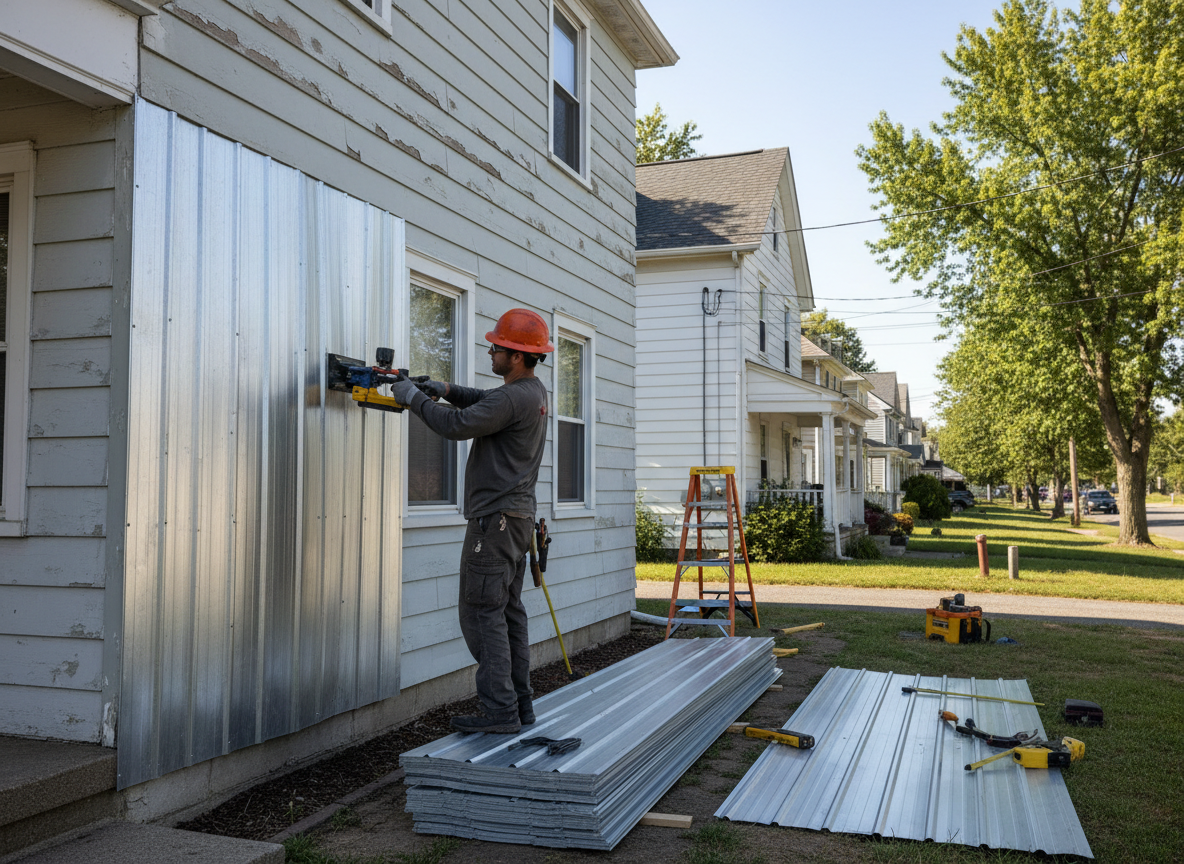
Aluminum siding remains common on homes built in the 1970s through 1990s throughout Union and Ryle. Boone County’s humid subtropical climate brings frequent summer moisture that can trap behind panels if weep holes are blocked, leading to hidden corrosion at the base. Mild winters reduce freeze-thaw cycles but allow condensation to form on cooler mornings, especially on north-facing walls near Union Community Park. Proper removal of old felt paper and installation of modern housewrap prevents moisture from reaching sheathing.
Homeowners in Florence and Burlington often request color-matched sections after hail or mower damage. Aluminum dents easily and shows every impact, so we carry factory-finished coil stock that matches original profiles without visible seams. We also check for proper nailing to avoid oil-canning on long runs exposed to afternoon sun. When replacing entire elevations we verify that existing insulation behind the siding still meets current energy codes for Boone County.
Seasonal Considerations
Mild winters mean crews can work most months, yet high summer humidity slows adhesive curing on trim pieces. We schedule exterior prep work early in the day before dew forms and use corrosion-resistant fasteners rated for coastal-grade exposure even though Union sits inland.
Common Edge Cases
Older Ryle homes sometimes have aluminum over original wood siding. Removing the metal without damaging the substrate requires careful prying and reveals whether the wood needs treatment before new wrap and siding go on. We always photograph these conditions for the homeowner before proceeding.
Technician insight
In Union, the thing that catches most people out with aluminum siding is how quickly summer humidity gets behind dented panels near the ground on Ryle homes; once the original felt paper fails, the sheathing starts to soften within two seasons and homeowners only notice when the bottom course bows outward.
Ryle Home Base Course Replacement
Panels along the rear had dented and bowed after years of mower strikes. We found saturated felt paper and soft OSB behind the lowest three feet. We removed the damaged aluminum, replaced the wrap, installed new matching panels with added weep holes, and the homeowner reported no further moisture issues after the next heavy rain.
How it works
- 1
Site Assessment
We walk the full elevation, note dent patterns, check for loose panels, and test for trapped moisture behind the siding.
- 2
Material Selection
We measure profiles and order matching aluminum coil or panels that withstand Boone County humidity without rapid fading.
- 3
Preparation and Wrap
Old felt is removed, sheathing is inspected, and a breathable housewrap is installed with taped seams.
- 4
Installation
New siding is hung with proper expansion gaps, weep holes are maintained, and trim is sealed at all joints.
- 5
Final Walkthrough
We review every elevation with the homeowner and note any future maintenance points around windows and doors.
Pricing
Cost depends on square footage, number of elevations, and whether wrap or insulation upgrades are needed; we provide upfront written estimates after inspection.