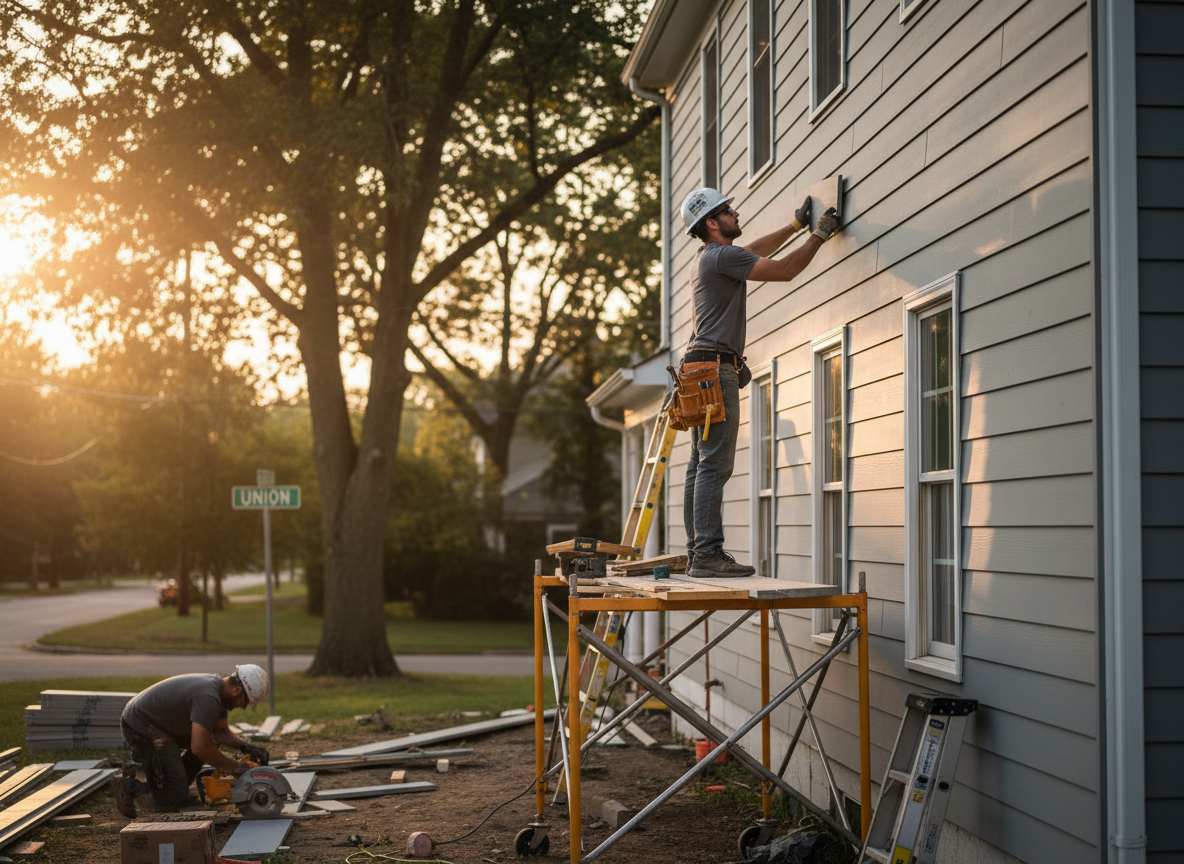
Union and Ryle neighborhoods in Boone County feature a mix of mid-century ranch homes and newer builds near Union Community Park. Humid subtropical weather with mild winters brings consistent moisture that can warp wood siding and promote mildew on vinyl or fiber cement. Burlington and Florence commuters often see the same pattern on properties where drainage slopes toward foundations. Proper underlayment and ventilation details matter more here than in drier climates because trapped humidity accelerates rot behind panels.
Contractors working these streets learn to check for ice dam remnants even in mild winters and to account for the clay-heavy soils that hold water against lower courses. In Ryle, many homes from the 1980s have original aluminum siding that has oxidized; replacement requires matching expansion gaps to prevent buckling during summer humidity spikes. Florence corridor properties sometimes sit on slight grades that direct runoff under siding edges, so flashing at transitions becomes critical. Site visits always include probing sheathing for softness before any new material is ordered.
Code requirements in Boone County emphasize wind-load ratings for exposed elevations and proper housewrap overlaps. Local crews know to extend wraps six inches past corners on Union homes where prevailing winds come from the southwest. Mild winters reduce freeze-thaw cycles but increase the need for insect screening at soffit returns because termite pressure stays year-round. Every job starts with a full elevation inspection to catch hidden damage from previous poor drainage fixes.
Technician insight
In Union, the thing that catches most people out with siding contractor near me is the clay soil around Ryle homes that keeps moisture against the bottom two courses long after rain stops. Mild winters here do not dry things out the way colder climates do, so rot often hides behind the first row of siding until we pull it. Checking the grade at the foundation before quoting saves surprises later.
Ryle Home Siding Refresh
Homeowner in Ryle noticed soft spots near the foundation after several humid summers. Inspection revealed rotted sheathing where runoff pooled against the original vinyl. We removed the lower courses, replaced damaged OSB, added new flashing, and reinstalled matching siding with improved drainage clearance. The home now sheds water properly without visible changes from the street.
How it works
- 1
Initial Site Visit
Measure all elevations, note existing materials, and check for moisture intrusion around windows and doors in Union homes.
- 2
Material Selection
Review options suited to Boone County humidity and provide samples matched to the home's age and style.
- 3
Removal and Prep
Strip old siding, inspect sheathing, replace damaged sections, and install new housewrap with taped seams.
- 4
Installation and Finish
Hang new siding with correct expansion gaps, install trim, and seal all penetrations before final walkthrough.
Pricing
Upfront quotes after on-site inspection; cost varies by material choice, home size, and extent of hidden damage.