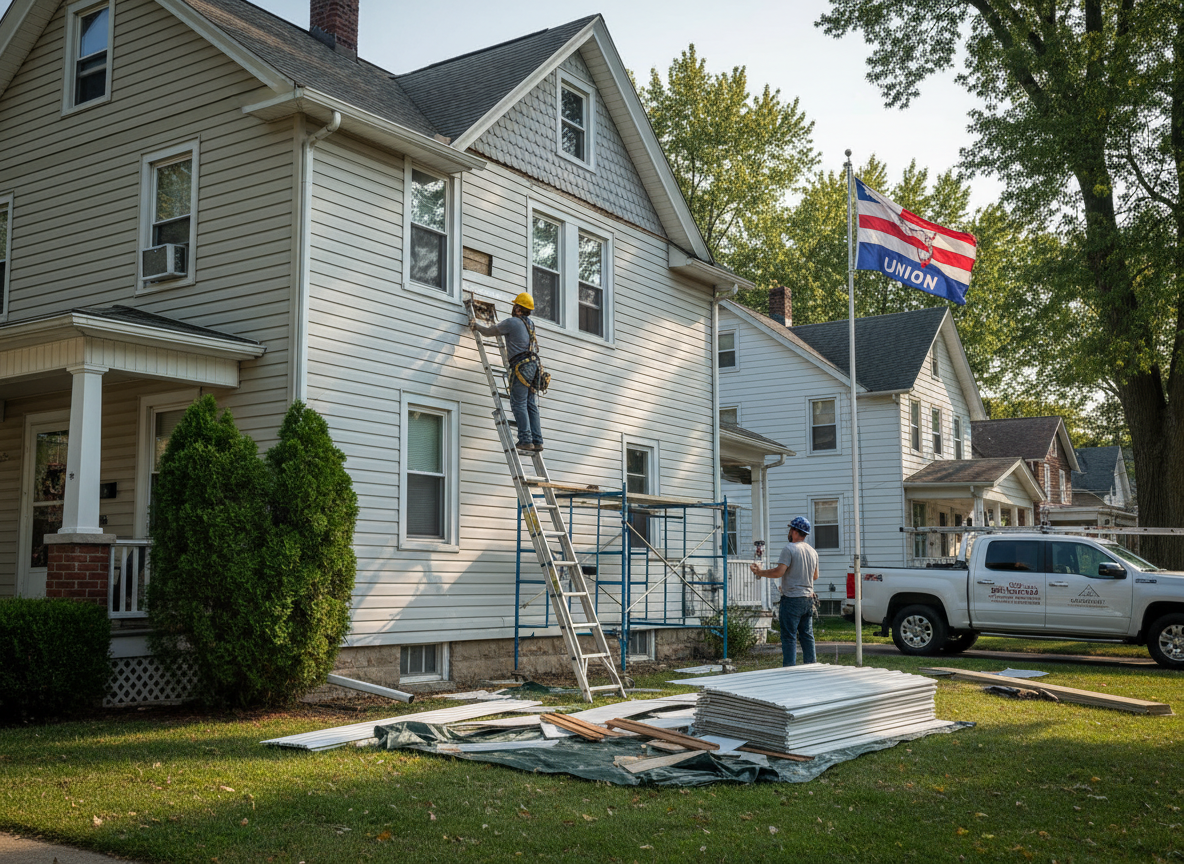
Homes in Union and Ryle often feature vinyl or fiber cement siding installed on 1990s and early 2000s builds common throughout Boone County. High humidity combined with mild winters allows moisture to linger behind panels, especially where original flashing was installed without proper overlap at corners or around windows. This leads to hidden wood rot that only appears once a section is removed, requiring contractors to inspect sheathing and replace compromised sections before new siding can be fastened.
Work near Union Community Park and along US-42 frequently involves properties with slight slopes that direct rainwater toward foundations. Siding repairs here must account for soil moisture retention that wicks upward into lower courses. Technicians routinely check weep holes and add furring strips to create drainage gaps, preventing recurrence during the next heavy summer storm that moves through from Florence or Burlington.
Repairs in these neighborhoods also address impact from falling branches and temperature swings that cause expansion gaps to widen. Matching existing profiles and colors demands sourcing from regional suppliers rather than big-box stock to avoid visible patches. Proper nailing schedules and expansion allowances keep new sections from buckling when humidity returns after a dry spell.
Technician insight
In Union, the thing that catches most people out with siding repair contractors is how mild winters let humidity keep feeding rot behind vinyl on 1990s homes in Ryle, so a small exterior crack often means pulling far more panels than expected once you open the wall.
Buckled Panels After Summer Storms
Homeowner in Ryle noticed several bowed sections near the rear elevation. Inspection revealed water trapped behind the siding due to inadequate original flashing on a home typical of Boone County builds. We removed the damaged courses, replaced rotted sheathing, added proper drainage gaps, and reinstalled matching siding. The repair stopped further intrusion through the humid season.
How it works
- 1
Initial Inspection
Technician examines all elevations, probes for soft spots, and documents moisture intrusion points specific to Union and Ryle construction.
- 2
Damage Assessment
Remove affected panels to inspect sheathing and framing, noting any rot caused by local humidity patterns.
- 3
Material Matching and Prep
Source matching siding and prepare substrate with improved flashing and drainage tailored to Boone County conditions.
- 4
Installation and Finish
Install new sections with correct spacing, seal penetrations, and verify integration with existing siding.
- 5
Final Walkthrough
Review completed work with homeowner and explain maintenance steps for ongoing humid weather exposure.
Pricing
Upfront quotes provided after on-site inspection; final cost depends on extent of hidden damage and material type.