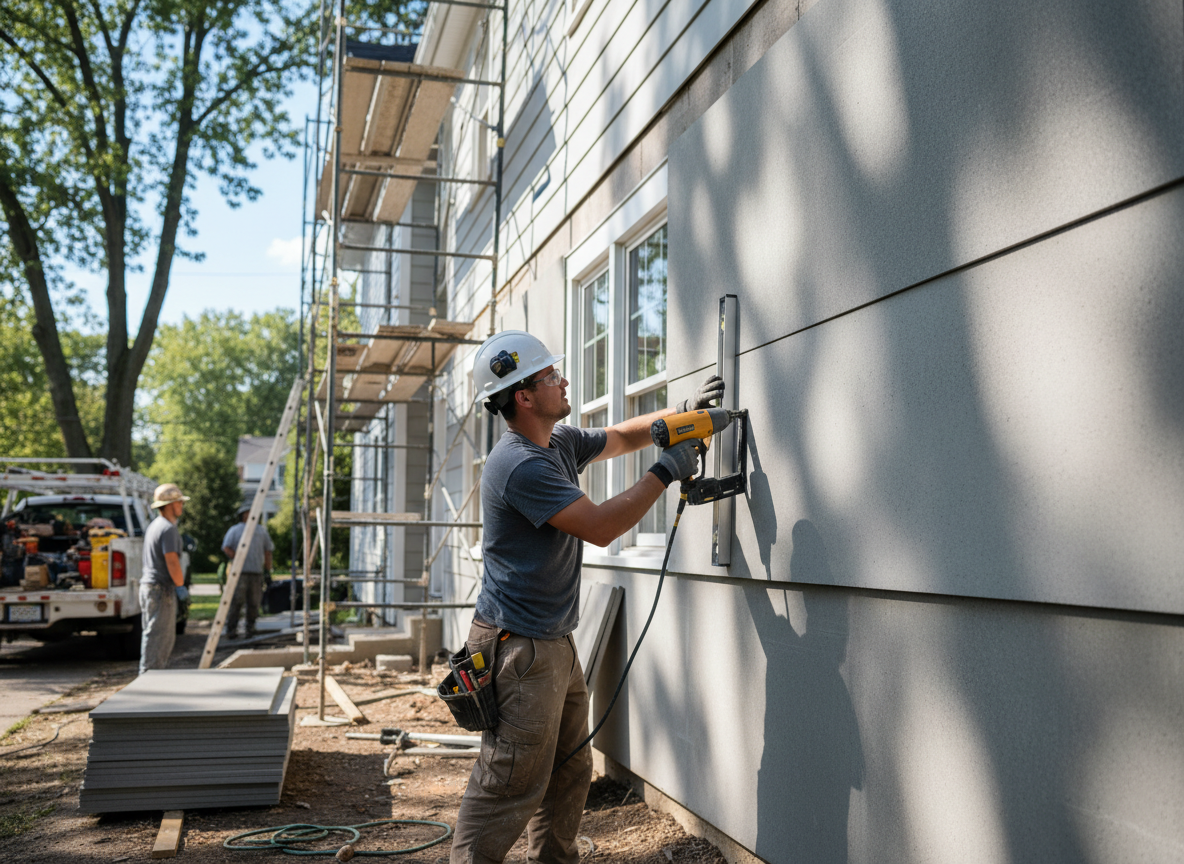
Cement siding performs well in Boone County's humid subtropical climate but demands precise sealing around windows and at grade to stop moisture wicking during mild winters. Homes in Union and Ryle often feature mixed-age stock where original fiber cement meets newer insulated panels; transitions require back-venting and proper Z-flashing to avoid trapped vapor. Burlington and Florence crews see the same pattern on north exposures where dew lingers longest.
Edge cases include soil creep along slight slopes near Union Community Park that pushes siding boards out of plane and code-mandated clearances above finished grade that many older Ryle properties violate. We always verify house wrap integrity and add weep screed where none exists rather than simply overlaying new boards. Skipping these steps leads to rot that shows up only after the next humid summer.
Never paint cement siding without first confirming the existing finish is fully cured and compatible; mismatched coatings blister quickly in our humidity. We also check for asbestos underlayment on pre-1980 Union homes before any demolition. Proper torque on fasteners prevents micro-cracks that expand during temperature swings between day and night in Boone County.
Technician insight
In Union, the thing that catches most people out with cement siding contractors is hidden moisture behind boards on north walls of Ryle homes where the humid subtropical air meets mild winter dew and poor original flashing, turning small gaps into rot before the next summer.
Cement Siding Repair Near Union Community Park
Homeowner reported soft spots along the lower course after several humid seasons. We found missing flashing and soil contact allowing water to wick up the cement boards. Replaced the bottom three courses, added proper clearance and new Z-flashing, then sealed all joints. The siding now sheds water without trapping humidity against the wall.
How it works
- 1
Site Assessment
Inspect existing cement siding, substrate, flashing and drainage on Union or Ryle homes, noting exposure and any prior repairs.
- 2
Moisture Mapping
Use moisture meters and visual checks to locate hidden water intrusion common in Boone County's humid conditions.
- 3
Material Selection
Choose thickness, texture and color-matched cement boards suited to local wind and humidity loads.
- 4
Installation and Detailing
Remove damaged sections, install new boards with correct fasteners, overlaps and ventilation, then seal all penetrations.
- 5
Final Walkthrough
Review drainage, clearances and finish with the homeowner to confirm performance in mild winter and humid summer cycles.
Pricing
Upfront written quotes provided after on-site assessment; final cost depends on square footage, access and extent of substrate repairs.