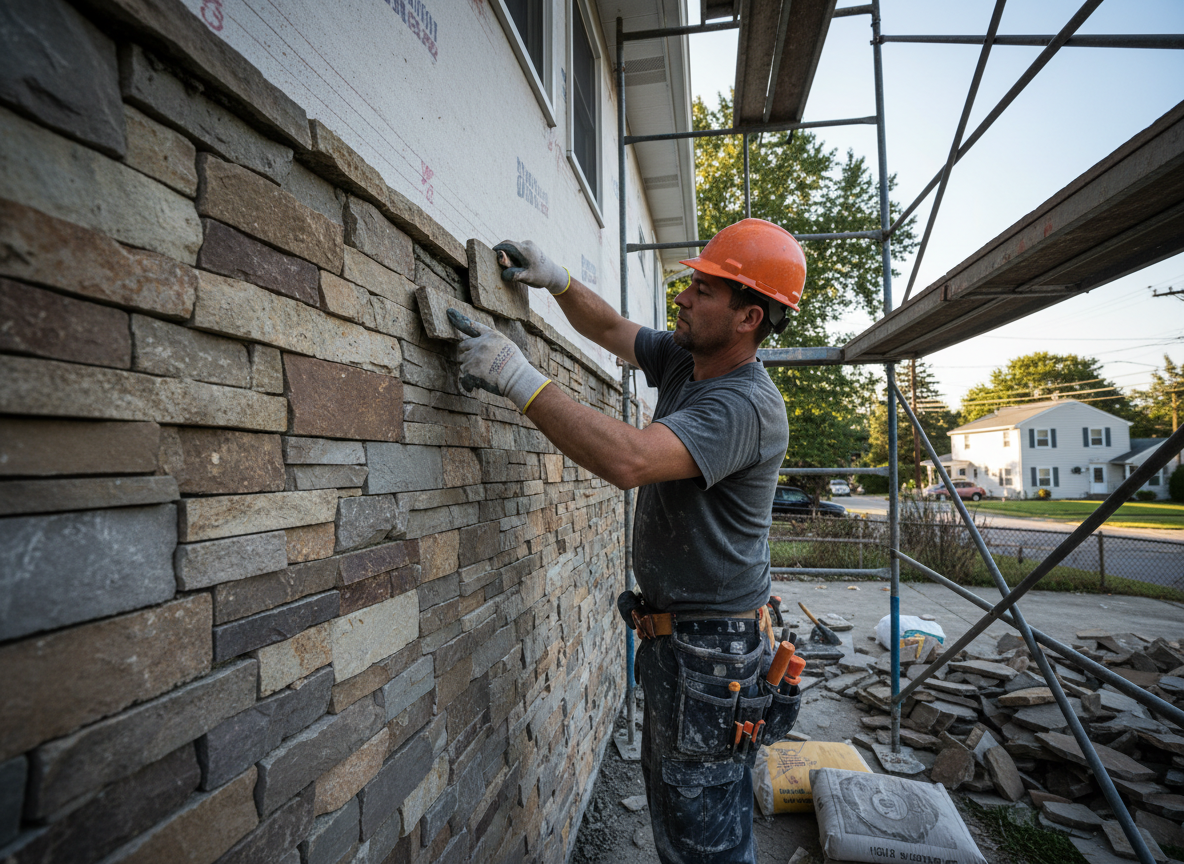
Stone veneer siding requires careful substrate prep in Boone County because many Union and Ryle homes built from the 1970s onward sit on clay-heavy soils that hold moisture. Installers must install proper drainage planes and weep holes to prevent water from migrating behind the veneer during the humid months when mild winters rarely allow full drying cycles. Homes near Union Community Park often sit on slightly sloped lots where runoff concentrates at foundation lines, so we flash lower courses extra carefully and tie into existing gutters before any stone goes up.
Material choice matters on Florence Road and US-42 corridors where wind-driven rain hits west-facing walls hardest. Thin natural stone adheres best over cement board with stainless ties rated for coastal exposure even though we are inland, while manufactured veneer needs tighter joint spacing to avoid cracking when temperatures swing between 20 and 85 degrees. We always pull permits through Boone County Building Inspections and verify that any existing wood siding is sound before covering, because trapped rot shows up years later once the veneer is in place.
Edge cases appear on split-level homes common in Ryle where rooflines step down and create multiple ledger boards. Each ledger must slope outward and receive continuous flashing or water finds the seam between stone and housewrap. We also check attic ventilation because added thermal mass from stone can change how the home breathes in summer humidity.
Technician insight
In Union, the thing that catches most people out with stone veneer siding is how the humid subtropical air keeps moisture behind the veneer on 1980s Ryle homes when the original builder skipped a proper drainage mat; the mild winters never freeze it out, so rot hides until the stone starts to push away from the wall.
Ryle Split-Level Stone Repair
Homeowner noticed water staining at the base of the west wall after heavy spring rain. We found missing flashing at the ledger and saturated OSB behind the existing veneer. We removed the lower three courses, installed new drainage mat and stepped flashing, then reset matching stone and restored positive slope away from the foundation.
How it works
- 1
Site Assessment
Walk the property in Union or Ryle, check substrate, drainage, and exposure to prevailing winds.
- 2
Substrate Prep
Install weather-resistant barrier, drainage mat, and metal lath over sound sheathing.
- 3
Layout and Flashing
Mark stone courses, install base flashing and weep screed at all transitions.
- 4
Adhere and Grout
Apply mortar, set veneer, tool joints, and seal penetrations before final cure.
- 5
Final Walk
Inspect drainage paths and clean up around Union Community Park access points.
Pricing
Cost depends on stone type, wall height, and existing siding condition; we provide upfront quotes after the site visit.